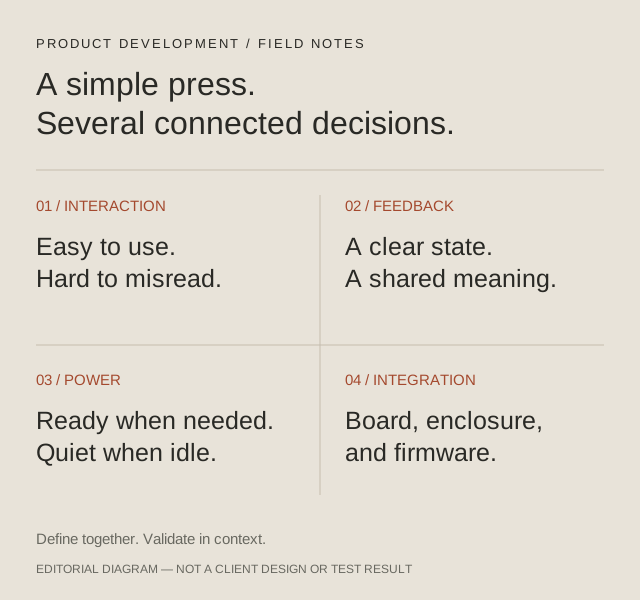
A guest presses for service. The light responds. Staff see the request. Behind that simple experience, the enclosure, electronics, firmware, and operating conditions need to work together.
Before a build can move ahead, the product interfaces, prototype evidence, and engineering files need to match. A handover should make those connections visible to the next team.
This note explores what to confirm before the next build, and how to agree a manageable first task when some evidence is missing.
- InterfacesBoard, enclosure, and firmware behaviour.
- Prototype evidenceWhat has been built, checked, and left open.
- Usable filesThe revision and build inputs the next team can use.
Why our proposal included a physical build
Our proposed work brought enclosure and board design, existing-firmware adaptation, assembled prototypes, interface and functional checks, agreed corrections, and engineering-file handover into one development cycle. The physical build would test the questions Vexera was being asked to resolve.
Prototype findings would feed back into the files before design freeze, against checks and acceptance criteria agreed at the start. Full tooling DFM was outside this proposal; it would need separate work defined around the chosen production process.
A design-only fee and a development fee covering prototypes, validation, and corrections purchase different work. Compare the deliverables, checks, and responsibilities behind each price.
Review the interfaces as a system
Typical checks include button travel against the switch and firmware behaviour; connector alignment and cable access; and space for the battery, antenna, and light path. A drawing can describe each part while leaving their assembled behaviour to be demonstrated.
A fit sample and a functional prototype answer different questions. Define what the next build must prove. For a battery device, the operating profile also matters: active requests, waiting time, lighting, connection activity, and charging all affect what should be measured.
Can the next engineer use the files?
Editable projects, manufacturing exports, and test records serve different purposes. Agree a handover checklist: which revisions match the sample, what remains open, and what the next team can inspect or rebuild. A folder of files alone leaves those questions unanswered.
| Package | What to confirm |
|---|---|
| Mechanical | Editable CAD and agreed exchange files, critical interfaces, and the relevant prototype revision. |
| Electronics | Schematic and PCB design files, fabrication outputs, and a BOM tied to the build baseline. |
| Firmware | Agreed source access and handover permissions, the build environment, dependencies, and configuration for the intended release. |
| Validation | Checks performed, observations, limitations, and corrections connected to the same build baseline. |
When existing firmware is a useful starting point
Existing firmware can be useful when it builds in the agreed environment, matches the target hardware and interfaces, and can be tested against the required behaviour. Adaptation can then focus on the changes the product needs.
Source availability does not by itself establish that baseline. Missing dependencies, unclear configuration, or undocumented interface assumptions can require investigation. Firmware handover also needs an explicit agreement: in our proposal, source-code handover was subject to written confirmation, including relevant third-party restrictions.
Agree the takeover work before committing
Clients can keep their own engineers and suppliers. Before accepting design or release responsibility, we need to establish the available files, prototype evidence, open questions, and revision to work from. An initial review can identify whether the next task is a focused check, a corrective build, or further development.
Investigation, build-environment recovery, and re-validation take engineering time. They may add hours, another prototype round, or schedule uncertainty. Assess, price, and approve that work separately from fabrication or assembly, so a file transfer does not become an undefined repair commitment.
Corrections already included in an agreed Vexera development scope remain part of that scope. New requirements or recovery work outside it need their own agreement. This distinction makes costs and responsibility clearer for both teams.
Start the engineering conversation early
Early discussion lets the team align interfaces, prototype goals, production assumptions, and file handover before those decisions become difficult to change. It can begin with one focused review and grow around the evidence needed for the next step.
Clients do not need to arrive as hardware experts. We do need willingness to share relevant information, agree checks, and address findings. Where an assignment asks us to accept design or release responsibility without a workable route to review, corrections, and validation, we may decline it. Production inspections against an existing approved specification can be scoped separately.
Before a design handover is accepted
- The product stage, next decision, and intended manufacturing process
- The available design baseline, files, and appropriate access permissions
- Existing prototype evidence and a plan for missing DFM or validation checks
- Included corrections and separately approved investigation or recovery work
- Decision owners and acceptance criteria for the next release
Bring us in while the architecture, interfaces, and handover expectations are still being shaped. If you already have a design, start with a non-confidential description of its stage and what the next build needs to prove.
About this early-stage enquiry
This enquiry began with a request for coordinated development. Our proposal included design, prototypes, engineering validation, and an agreed file handover. The client later commissioned the design separately and returned to discuss build support.
They reported that prototyping and DFM had not been completed. We declined the assignment before receiving or auditing the files. The wider lesson is what to confirm before taking responsibility for a design developed elsewhere.
An anonymized engineering note, not a completed Vexera case study. The external files were not received or audited. Technical examples are general review considerations, not findings about that design. The image is an AI-generated concept; customer identity, pricing, and implementation are omitted.
Explore the development questions